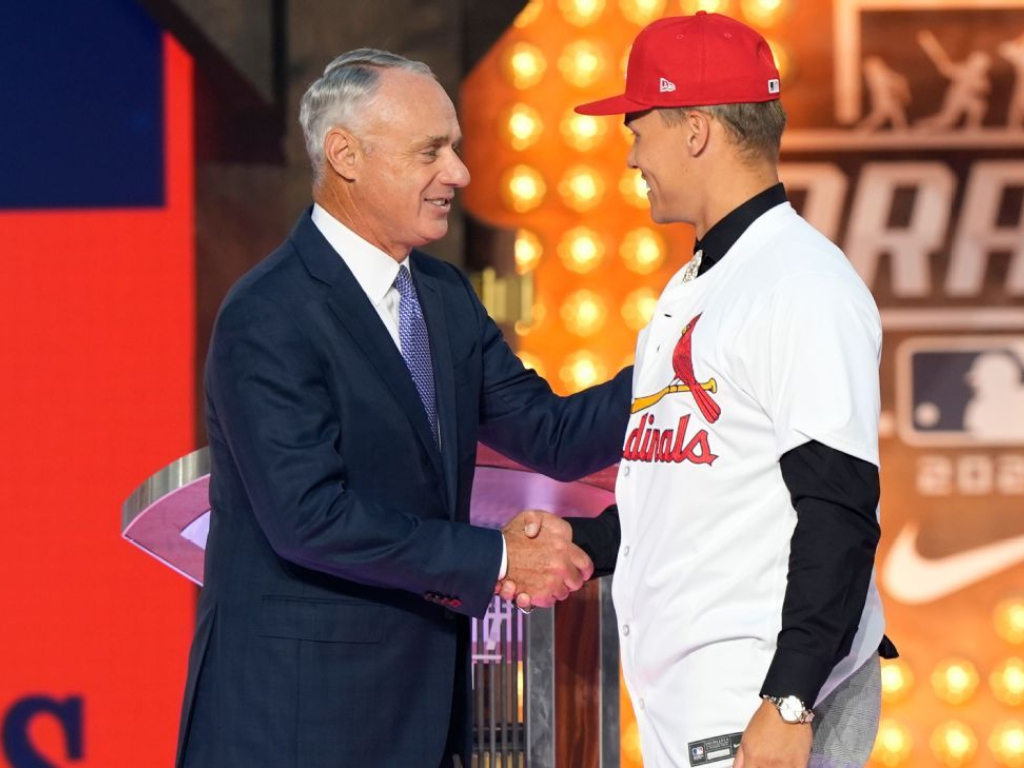
How Baseball Players Get Paid
When a baseball player hears their name called on draft day, the excitement isn’t just about reaching the big leagues, it’s also about money. But how exactly do players get paid, and how are those signing bonuses structured? Let’s break it down in a way even casual fans can understand.
→ Go Back: The MLB Draft Explained: Lottery Picks, Competitive Balance, and Why “Cant-Miss” Often Misses
Signing Bonuses: The Upfront Cash
For most drafted baseball players, the first real paycheck comes in the form of a signing bonus. This is a lump sum paid once a player agrees to a professional contract. The size of that bonus varies widely and depends on several key factors.
Draft position plays a major role. Players selected early in the draft usually receive much larger bonuses. A top ten pick may sign for millions of dollars, while players chosen in later rounds often receive bonuses in the hundreds of thousands or less.
Leverage also matters. High school players who have the option to attend college can negotiate more aggressively, since teams risk losing them if a deal is not reached. College seniors generally have less negotiating power because they have fewer alternatives.
Another factor is the team bonus pool. Each organization is given a set amount of money to spend on its top ten draft picks. Spending extra on one player may force the team to save money on another, which can affect negotiations across the draft class.
While some signing bonuses are paid all at once, others are structured differently. Payments may be spread out over time, deferred to future years, or tied to incentives such as performance milestones, education commitments, or promotional appearances.
Minor League Salaries
After signing, players begin earning salaries in the minor leagues. These are typically paid weekly or monthly and vary by level.
At the Rookie and Single A levels, salaries are often very low, sometimes just a few hundred dollars per week. As players move up to Double A and Triple A, pay increases, but it still remains modest compared to major league standards.
Even with limited salaries, minor leaguers receive important benefits. They gain access to professional coaching, training facilities, medical care, and constant evaluation. These resources are essential for player development and for creating opportunities to advance toward the major leagues.
Performance Incentives
Some contracts include incentive clauses that reward players for hitting specific goals. These incentives are designed to motivate performance and development.
Common incentives include reaching the major league roster within a certain time frame, achieving statistical benchmarks such as home runs or stolen bases, or advancing quickly through the minor league system. In some cases, these bonuses can add hundreds of thousands of dollars to a player’s total earnings.
Bonuses Beyond Signing
In addition to signing bonuses and incentives, teams may offer other forms of compensation and support. These benefits often receive less attention but can be meaningful for young players.
Examples include tuition reimbursement for players who decide to pursue college education later, housing or travel allowances during the minor league season, and healthcare and insurance coverage. For players early in their careers, these benefits can significantly reduce financial stress.
Major League Paychecks
Once a player reaches the major leagues, their earnings change dramatically. Salaries increase sharply, and players become subject to team controlled contracts, salary arbitration, and eventually free agency.
At this stage, pay is governed by league rules, service time, and negotiation power. For those who establish themselves, major league contracts can become the most lucrative phase of a baseball career.
Bottom Line
A baseball player’s earnings begin with a signing bonus, continue through minor league salaries and incentives, and can grow substantially if they reach the major leagues. The system balances upfront rewards with long term development, motivating players to improve while allowing teams to invest carefully in future talent. In many ways, baseball players are paid similarly to workers in other industries, with early entry compensation, performance based rewards, and the potential for significant growth over time.
→On to: Signed Before The Prom: How International Signees Get Into Baseball
Share this content:
Post Comment