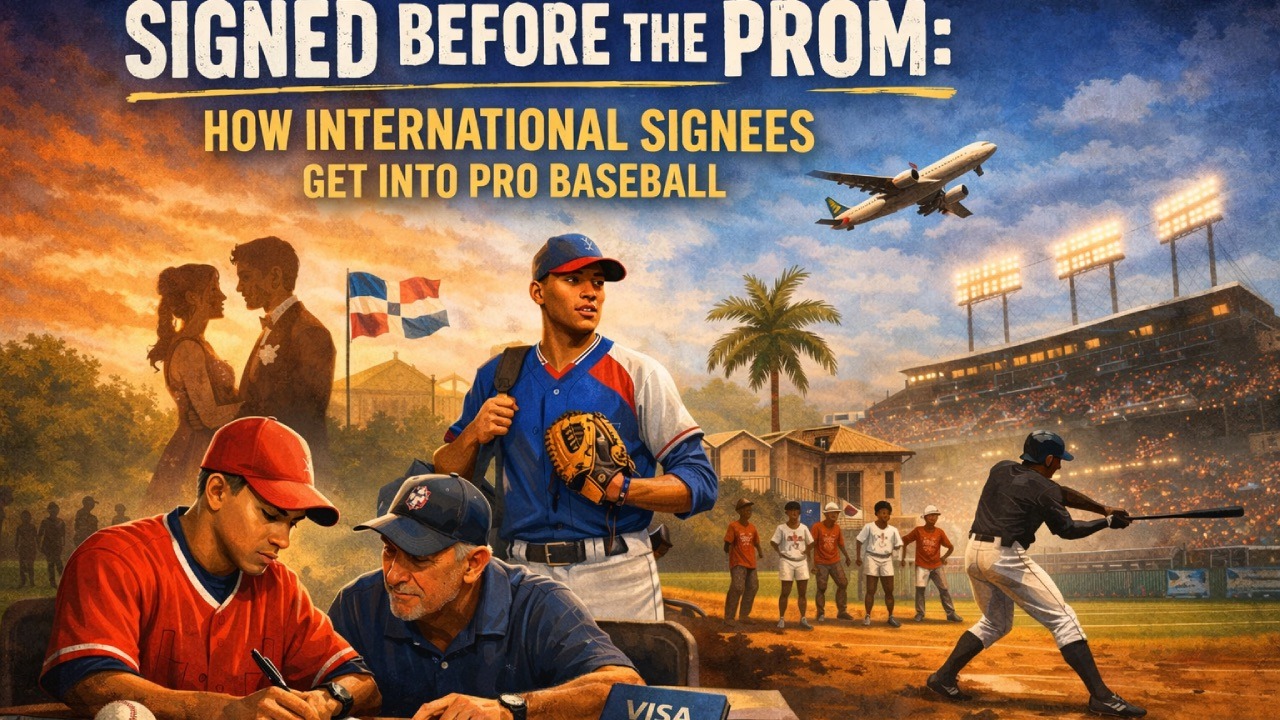
How International Signees Get Into Pro Baseball
When fans think about baseball prospects, they usually picture the MLB Draft. College stars. High school phenoms. Big signing bonuses on TV.
But for thousands of players around the world, the road to pro baseball looks very different.
Welcome to the world of international signees and how they emerge in pro baseball; where the journey often starts years earlier, far from bright lights, and long before anyone’s checking box scores.
→ Previous Article: From Draft Day to Payday: How Baseball Players Get Paid
Who Is an International Signee?
An international signee is a player who:
- Lives outside the United States, Canada, and Puerto Rico
- Is not eligible for the MLB Draft
- Signs directly with an MLB organization as a free agent
Most international signees come from:
- Dominican Republic
- Venezuela
- Cuba
- Mexico
- Colombia
- Panama
- Japan, South Korea, Taiwan (select cases)
The majority sign between ages 16–18.
Yes, some are literally still in high school.
The July 2 (Now January) Signing Period
For years, international amateur signings centered on July 2. That date no longer exists on the calendar, but the structure behind it remains firmly in place.
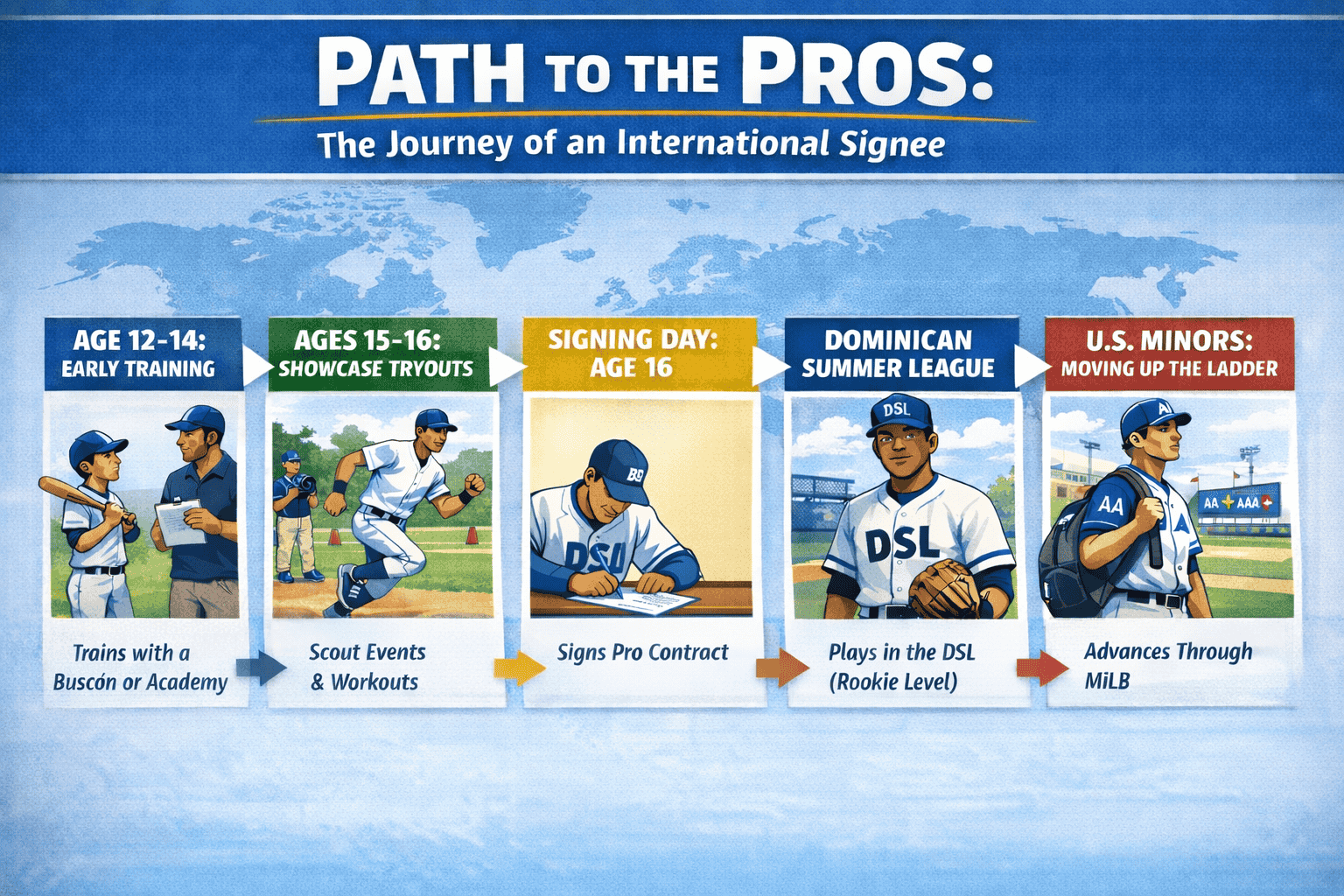
Today, the international signing period typically opens in January. Each MLB team is assigned a bonus pool that it cannot exceed, placing strict limits on total spending. Players are eligible to sign once they turn 16 years old, which makes this one of the earliest entry points into professional sports.
Most deals are not spontaneous. Many are verbally agreed to years in advance and finalized the moment the signing window opens. By the time signing day arrives, a large number of players already know which organization they will join, how much their signing bonus will be, and where they will report next.
Buscones: The Middlemen of the System
This is the part of the international system most fans never hear about.
Many international prospects train under Buscones, independent trainers who operate outside of MLB organizations. These trainers often identify talent at a very young age, sometimes as early as 12. They provide coaching, housing, and food, and they market players directly to major league teams. In return, they take a percentage of the player’s signing bonus.
The role of Buscones is complex and controversial. Some are life changing mentors who open doors that would otherwise remain closed. Others leave players with little money, limited education, and few options if baseball does not work out.
There is no single experience. For many players, Buscones are the foundation of their opportunity. For others, they are a source of long term regret. It remains baseball’s least regulated pipeline and one of its most influential.
The Showcase Circuit
International prospects do not follow the same path as U.S. players through high school and college baseball.
Instead, they are evaluated through private workouts, team run academies, and showcase events packed with scouts. These showcases are brief, intense, and unforgiving. Players are judged in moments rather than seasons.
A typical showcase may include 60 yard dashes, infield and outfield drills, live batting practice, and constant radar gun readings. One poor performance can cost a player thousands of dollars in bonus money. One perfect swing can change a family’s future.
Signing the Contract: What Do They Actually Get?
International signing bonuses vary dramatically in pro baseball. Some players sign for as little as $5,000. At the top of the market, elite prospects may receive anywhere from $1 million to $5 million.
Even with a large signing bonus, the money does not always stretch as far as it seems. Signing bonuses are often divided among family members, trainers, and taxes. Once signed, players immediately enter the minor league pay structure, where salaries are modest and guarantees are limited.
For many players, the bonus is not wealth. It is survival, opportunity, and responsibility wrapped into a single check.
Life After Signing: Culture Shock Is Real
After signing, most international signees report either to the Dominican Summer League or to a team’s U.S. based training complex for pro baseball.
The transition can be overwhelming. Players face language barriers, homesickness, unfamiliar food and weather, and competition against older and physically stronger opponents. While some adapt quickly, others struggle in silence.
Development at this stage is not just physical. It is emotional, cultural, and mental.
Why So Few Make It
Each year, thousands of players sign international contracts. Only a small percentage will ever reach the major leagues.
The reasons are numerous. Limited roster spots, injuries, late physical development, inconsistent instruction, and off field challenges all play a role. As a result, many players are released before they turn 22, often without a clear path forward.
Still, every signing period brings a new wave of hope.
Why Teams Invest So Heavily
Despite the risks, teams continue to pour resources into international scouting. The potential reward is enormous.
Many of today’s stars signed internationally, including:
- José Ramírez
- Ronald Acuña Jr.
- Juan Soto
- Fernando Tatis Jr.
- Shohei Ohtani (through a different posting system)
For an organization, one successful signing can reshape an entire franchise.
For a player and their family, it can reshape generations.
The Human Side of the System
International signing is not just baseball business. It is built on hope.
Hope for families, communities, and entire neighborhoods. When a 16 year old signs his first professional contract, he is not simply joining a farm system. He is carrying expectation, sacrifice, and the weight of home.
Final Thought
The next time a broadcaster says, “Signed as an international free agent at 16,” remember what that sentence represents.
Years of training. Moments of risk. Commitment to belief.
It is one of the hardest and most remarkable paths to professional baseball.
→ Go Back: The MLB Draft Explained: Lottery Picks, Competitive Balance, and Why “Cant-Miss”Often Misses
Share this content:

1 comment